
· by Michael Blair, Nashville's Mover
An office move runs on a different clock from a house move. The business has to stop for as short a time as possible, two buildings set the rules for when the trucks can be at the dock, and the most valuable things on the truck are the ones with cables coming out of them. Owners who have moved house often expect the same estimate rules to apply. Most of what follows is how we plan the job itself; the first section is about the paperwork, because that is what decides what you pay and what is covered. The apartment and office moves page has the basics of how we work in elevator buildings.
Do the home-move estimate rules apply to an office move?
The federal estimate rules most people have heard of are written for interstate moves of household goods, and they define both the goods and the customer narrowly. 49 CFR 375.103 on the eCFR defines household goods as personal effects or property used in a dwelling, with the move arranged and paid for by the individual shipper, and it defines that individual shipper as the person who owns the goods and pays his or her own charges. The same section defines a commercial shipper separately. The survey and written-estimate duties in 49 CFR 375.401 are stated as duties owed to the individual shipper.
We do not tell a business owner what those definitions mean for their company; that is a question for the company’s own advisor. The practical point is simpler: a business move is priced and covered by the contract you sign, so get the scope, the valuation and the schedule in writing before the first desk is wrapped. If your question is about a household move, binding, non-binding and why quotes change covers that side.
- Scope: the inventory of what moves, what is disassembled, what is crated and what stays
- Valuation: what the mover is liable for if something is damaged, stated as a figure or a basis, and how a claim is filed
- Schedule: the start time, the elevator and dock windows in both buildings, and what happens if a window is missed
- Price basis: hourly by crew and truck, or a fixed price for the listed scope, and what counts as extra
How do you plan an office move inventory?
The inventory starts with a walk through every room with someone who knows which furniture is staying, which is going to storage and which is being replaced. We count desks, chairs, filing cabinets, conference tables, shelving, kitchen appliances and anything bolted to a wall, and we note what has to come apart to fit through a door or into an elevator.
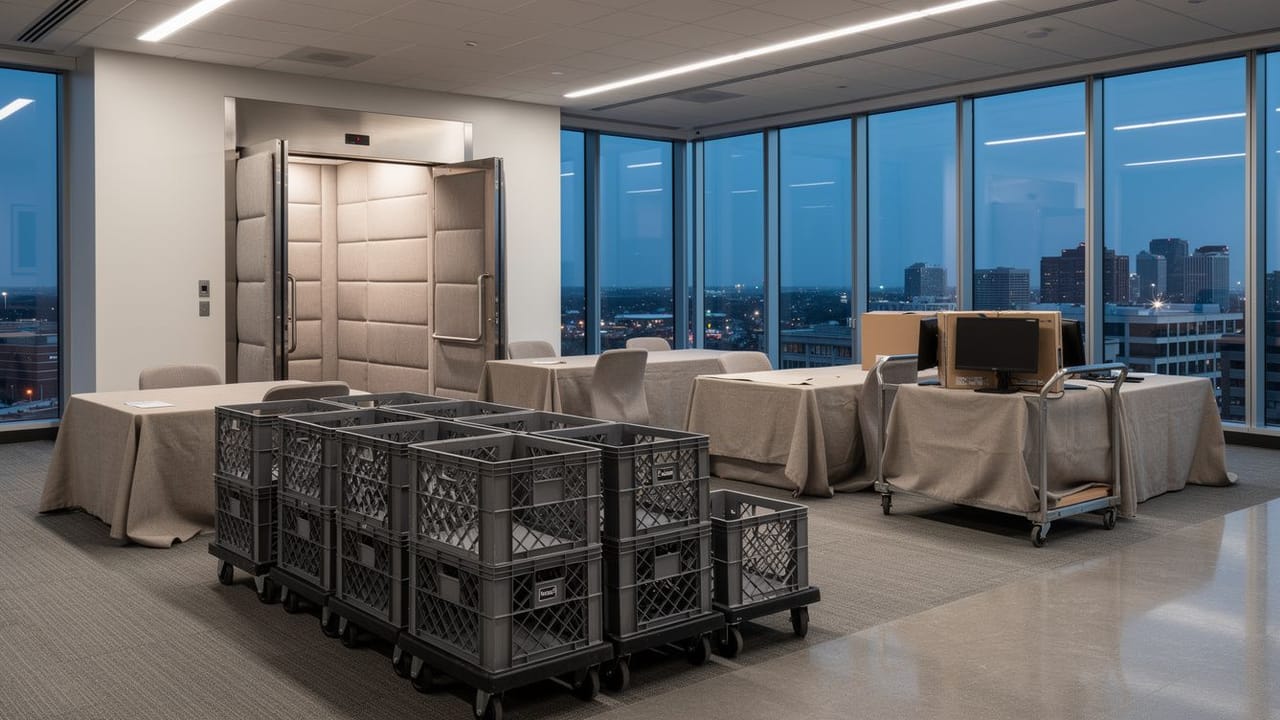
The labels come from the new floor plan, not the old one. Each person or room at the destination gets a number, every crate, chair and monitor carton from that desk carries the same number, and a copy of the plan is taped up at the new entrance so the crew unloads straight to the right spot instead of stacking everything in the lobby. Ask each employee to pack their own desk contents into crates and label them the day before; the personal things are the ones nobody else can sort.
Records need a decision of their own. Files that are confidential, or that the business cannot work without on the first morning, are worth moving in sealed, numbered crates and checking off at both ends. Our packing page covers what our crews pack for you and what is left to you.
How are computers, phones and furniture handled?
Plan for your IT person or vendor to disconnect, label and later reconnect the network, the phones and any server, while our crews wrap and carry the hardware. Cables are bagged and tagged with the same desk number as the computer they came from, monitors travel in padded cartons, and anything holding data the business depends on should be backed up before it leaves the building.
Office furniture is mostly a question of disassembly. Workstation panels, desk returns and conference tables usually come apart, and the parts and hardware for each piece stay together and labeled so it goes back up the same way. Filing cabinets and anything heavy on casters are wrapped and moved on dollies; at the walk-through we tell you which pieces have to be emptied first. A safe, a large copier or anything else unusually heavy is planned separately, the way our specialty moves are.
When should an office move happen, and what do the buildings require?
Most offices move after hours or over a weekend so the business closes on one day and opens on the next, but the time is often set by building management rather than by us. Downtown, the Gulch and Midtown buildings commonly require a booked freight elevator or dock time and a certificate of insurance from the mover, sometimes naming the building’s owner or manager, and both the building you are leaving and the one you are moving into will have their own rules. Ask each one for its move requirements in writing as soon as the date is close to settled, then send them to us with the details on our apartment and office moves page in mind, so the crew, the truck size and the start time fit inside those windows.
Event days and game days downtown can close streets and crowd the docks, so check the calendar before you commit to a Saturday. Wall and floor protection in the corridors and elevator is often a building requirement as well.
Then write the schedule into the contract, alongside the scope and valuation. If the move crosses a state line, 49 U.S.C. 14706 on GovInfo makes a carrier liable for actual loss or injury to the property under the receipt or bill of lading, says a carrier may not give less than nine months to file a claim, and, for property other than household goods, lets a carrier limit its liability to a value set by written declaration or agreement, so the signed paperwork matters. For a move inside Nashville or to Franklin or Brentwood, read the claim terms in the contract itself. When you have a date and an address, ask us for a written estimate and we will walk the office.
Sources
- 49 CFR 375.103, Definitions (eCFR) — How Part 375 defines household goods, the individual shipper and the commercial shipper
- 49 CFR 375.401, Must I estimate charges? (eCFR) — The survey and written-estimate duties, stated as owed to the individual shipper
- 49 U.S.C. 14706, Liability of carriers under receipts and bills of lading (GovInfo) — Carrier liability for actual loss, value set by written agreement, and the nine-month minimum to file a claim
FAQ
Moving an Office in Nashville: What to Put in Writing — questions
Do the same estimate rules for home moves apply to an office move?
The federal estimate rules in 49 CFR Part 375 are written for interstate moves of household goods, defined as property used in a dwelling and paid for by the individual who owns it. A business move is priced and covered by the contract you sign, so get the scope, the valuation and the schedule in writing first.
How do movers handle computers, servers and phones in an office move?
Your IT person or vendor disconnects, labels and later reconnects the network, the phones and any server, while our crews wrap and carry the hardware. Cables are bagged and tagged with the desk number, monitors go in padded cartons, and anything holding data the business depends on should be backed up before it leaves.
Do I need a certificate of insurance for an office move?
Usually, yes. Many office buildings, especially downtown, in the Gulch and in Midtown, ask the mover for a certificate of insurance before they release the freight elevator or dock, sometimes naming the building’s owner or manager. Ask both buildings for their move requirements in writing and send them to us early.
Who is liable if office furniture or equipment is damaged in a move?
The contract you sign sets that, so write the valuation into it as a figure or a basis, along with how a claim is filed. On a move that crosses a state line, federal law makes the carrier liable for actual loss under the bill of lading, and for property other than household goods allows a written agreed value.
How long do I have to file a damage claim after a commercial move?
For a carrier moving goods across state lines, 49 U.S.C. 14706 says it may not allow less than nine months to file a claim. For a move within the Nashville area, the claim window is whatever your contract states, so read those terms before you sign and keep the inventory to check against at delivery.