
· by Michael Blair, Nashville's Mover
A lot of what breaks on a move breaks because it moved inside its box. The National Park Service’s Conserve O Gram on packing museum objects for shipment names vibration from transportation and crowding inside the box among the hazards a packed object has to be protected against. It was written for museum staff shipping collections, and we pack your dishes by the same principle: a box with space in it lets its contents shift for the whole drive.
How full should a moving box be?
We pack to the top and fill every gap. The NPS guide does the same with museum pieces, filling excess space with tissue and adding a top layer of foam so the box is completely full and nothing can move. Our own test before a box is taped is a gentle shake and a lift: it shouldn’t rattle, and it shouldn’t flex.
Fragile things get room to be cushioned, though. For each object, that guide leaves a minimum of two inches of packing material between it and the box on every side, top and bottom, and says a box that is a little too large beats one that is too small. In a stack, an under-filled box can sag under the boxes above it, which is one more reason we fill to the lid.
Which things go in small boxes and which in large?
Books and other heavy things go in small boxes, and light bulky things like bedding and pillows go in large ones. A large box filled with books ends up heavier than one person can carry comfortably, and OSHA’s guidance on controlling ergonomic hazards lists reducing the weight of a load as a way to limit the force a lift takes, along with having heavy loads lifted by two people.
We follow both. A box that is too heavy for one of us gets repacked into two, and the dresser or the washer that does need two people gets two. If you’re packing yourself, a box you can pick up without straining is about the right weight.
- Fill every gap so nothing shifts
- Heavy items in small boxes
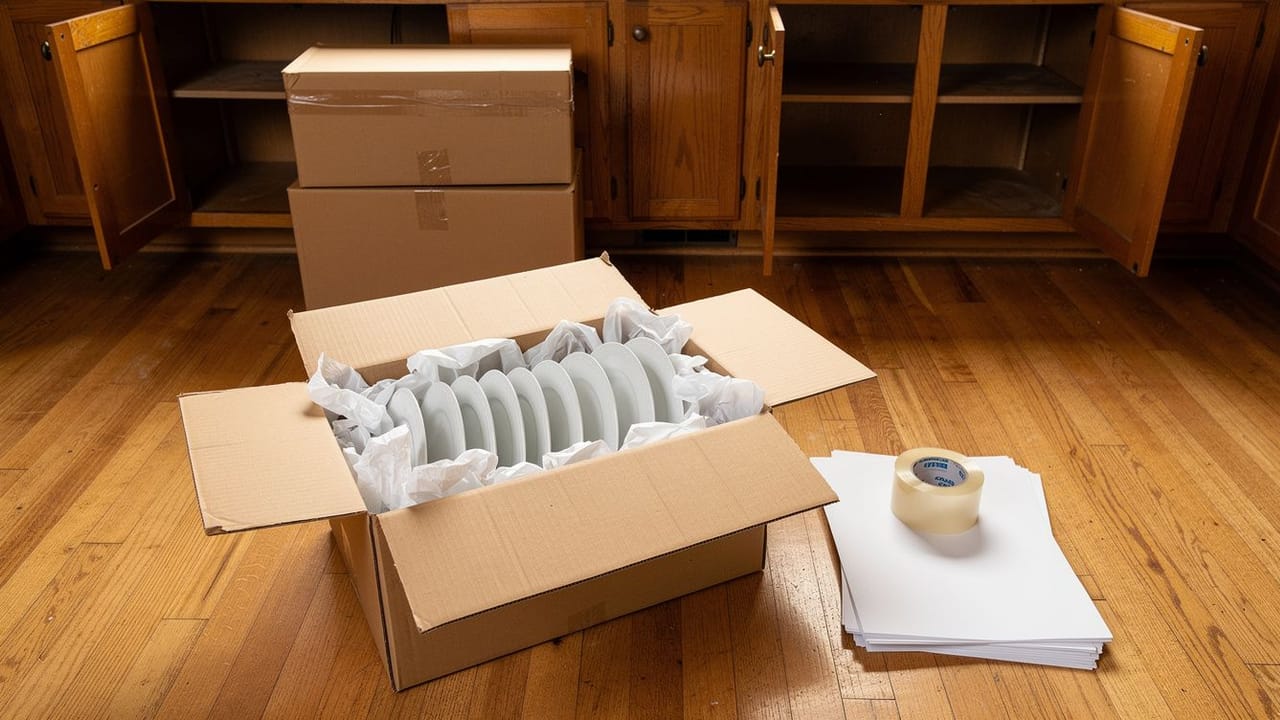
- Plates on edge with padding between
- Room and contents written on the side
- Fragile marked on more than one face
Plates on edge
We stand plates upright on edge in a dish pack, each one wrapped, with crumpled paper between them and a cushioned layer under the bottom row. The NPS guide’s rule for any fragile object is that it be properly supported at its strongest points. On edge, a plate rests on its rim with padding on both faces, instead of sitting under the weight of a stack.
People packing their own kitchens are often surprised by it, because a flat stack looks tidier. Glasses go in divided cells so no two touch. If you’d rather not wrap a kitchen’s worth of plates yourself, we can pack just the kitchen and leave the rest of the house to you.
Where should you label a moving box?
We write the room and the contents on the side of each box. The NPS guide lists contents on the box lid, which suits a box that is opened from above; on a truck and in a garage full of boxes, the tops are covered and the sides are what you can read. A number keyed to a list helps on a large move, the same idea as the box number that guide has museum staff record for every box.
Mark the boxes you’ll want on the first night so they stand out, and we’ll load them last so they come off first. Our post on the week before the movers arrive covers what else to set aside, and if something does arrive broken, what you’re paid depends on the coverage you chose, which our post on what moving coverage actually pays explains. When you know your dates, get a written estimate from us and tell us which rooms you’d like packed.
Sources
- National Park Service, Conserve O Gram 17/2: Packing Museum Objects for Shipment (1993) — Vibration from transportation and crowding as hazards; fill excess space so nothing moves; two inches of cushioning on every side; a box a little too large beats one too small; support at the strongest points; contents and box numbers listed on the lid
- OSHA, Ergonomics: Control Hazards — Reduce the weight of a load to limit force exertion; heavy loads lifted by two people
FAQ
Packing That Survives the Truck — questions
Why do packed boxes still break things?
Often because there was room inside for the contents to shift during the drive. The National Park Service’s guidance on shipping museum objects fills every gap so nothing can move, and we pack household boxes the same way: full to the lid, so the box doesn’t rattle when shaken or flex when lifted. An under-filled box can also sag when others are stacked on it. Wrapping each item still matters; filling the gaps and wrapping work together.
Should plates be packed flat or on edge?
We pack them on edge, each one wrapped, with padding between them and a cushioned layer under the bottom row. Standing on its rim, a plate is supported at its edge and padded on both faces, instead of carrying the weight of the plates stacked above it. Glasses go in divided cells so they don’t touch.
How heavy should a moving box be?
Light enough for one person to lift comfortably, which usually means books and tools in small boxes and bedding in large ones. OSHA’s ergonomics guidance recommends reducing the weight of a load and having heavy loads lifted by two people. We do both: a box too heavy for one of us gets repacked, and anything that needs two people gets two.
How do you pack glass vases for moving?
Wrap the vase and give it at least two inches of packing material between it and the box on every side, top and bottom, then fill the remaining space so nothing can shift. A box a little too large beats one too small, and mark fragile on more than one face.