
· by Michael Blair, Nashville's Mover
Most household items are a question of weight and boxes. A few are not, and we quote them on their own line because they need different equipment, more people and often a different insurance conversation. The federal booklet movers hand customers on interstate jobs, Your Rights and Responsibilities When You Move, lists piano carrying among the additional services a mover can charge for, and it has a separate flight charge for carrying items up or down stairs. Knowing why makes the quote easier to read.
Why are pianos and safes harder to move?
Weight concentrated in a small footprint is the first thing. A gun safe rests everything it weighs on four small feet, and a floor over a crawl space or a tile floor takes all of it at those four points. If you have any doubt about the floor where the safe is headed, have a contractor look at it before moving day; we would much rather hear about that floor on the phone than discover it with the safe on the dolly.
The second is height and balance. An upright piano is tall and heavy, and once something that size starts to tip, nobody is stopping it, so the crew’s job is controlling the load more than lifting it. A piano is also a wooden instrument, and the Piano Technicians Guild’s page on humidity control explains that changes in humidity make its wood parts swell and shrink, which affects how well it holds its tuning.
What equipment do piano and safe movers use?
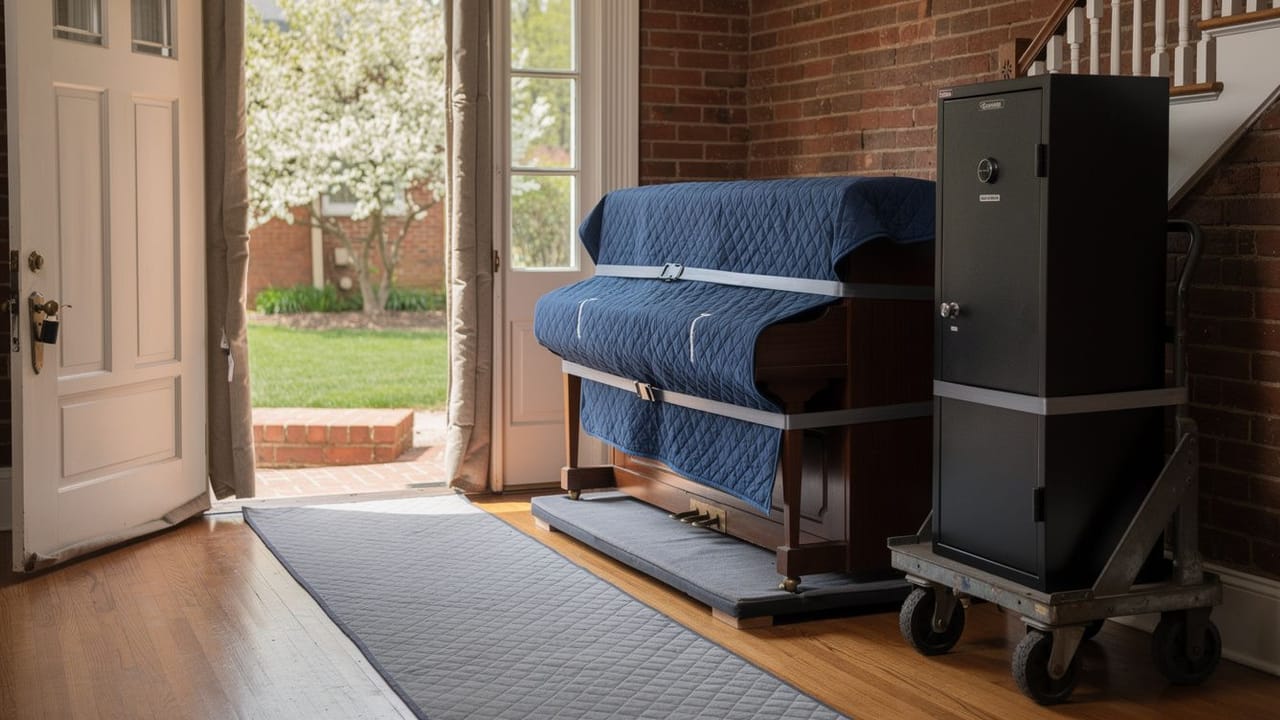
A piano board and straps for an upright. A skid board for a grand, which we move on its side with the legs and lyre off. Stair-climbing dollies and rigging for safes, and enough people to control the load rather than to carry it. That kit is what our piano and safe moves are built around.
Also floor and door protection, which is not a courtesy. The house takes its own share of risk on a heavy move: a door jamb split, a stair tread gouged, a hardwood floor scarred by a wheel that picked up grit.
- Ask which equipment they will bring for this particular item
- Confirm how many people will be on the job
- Ask about floor, stair and doorway protection
- Measure the route yourself, including turns and handrails
- Get the specialty item named on the estimate and the shipping paperwork
Does per-pound moving coverage protect a piano?
Coverage figured by the pound is close to meaningless for a valuable instrument. On an interstate move, that same federal booklet sets released value at 60 cents per pound per article, and its own example is a 10-pound stereo component worth $1,000 that pays out no more than $6.00. A piano covered that way will not be made whole if the soundboard cracks. The default runs the opposite way from what many people expect, though: the booklet makes Full Value Protection the coverage you receive unless you waive it in writing, and released value is what that signed waiver leaves you with. The federal booklet governs interstate moves, so on a move inside Tennessee read the valuation line on the estimate instead of assuming either default. Our post on what each level of moving coverage pays goes through the options in more detail.
For anything genuinely valuable, ask about full value protection and whether high-value items need to be declared individually. Under the booklet, a mover may limit its liability for an article of extraordinary value, meaning one worth more than $100 per pound, unless you list it on the shipping documents; the examples it gives are things like jewelry, silverware, china and antiques. Ask your homeowner or renter insurer, too, whether your policy covers the piano while it is on a truck. If something does arrive damaged on an in-state move, Tennessee’s rules for household goods carriers require the mover to acknowledge a written claim, in writing, within 30 calendar days. Either way the time to settle coverage is before the truck arrives, not after.
Firearms, and the part people get wrong
Many movers will not carry firearms or ammunition. That is each company’s own policy, so ask for its written list of what it will not load, and our post on what movers will not put on the truck covers the rest of that list. Whatever the policy, the booklet says federal law forbids shipping hazardous materials in your household goods without informing your mover, so anything stored in the safe that might fall under that, ammunition included, is a conversation to have well before loading day.
On a long-distance move out of Tennessee, transporting firearms also involves state law at both ends. The federal safe-passage provision, 18 U.S.C. 926A, lets a person carry a firearm from a place where they may lawfully possess it to another place where they may lawfully possess it, provided it is unloaded and neither the gun nor any ammunition is readily accessible from the passenger compartment. It is written for a person transporting their own firearm and it assumes the gun is legal at both ends, so check the law where you are going rather than assuming. That is a genuine reason to plan the safe as an empty object being moved and its contents as a separate task entirely. When you know what is going and where, send us the details for a written estimate.
Sources
- U.S. DOT / FMCSA, Your Rights and Responsibilities When You Move (49 CFR Appendix A to Part 375), Cornell LII copy — Piano carrying as an accessorial service; flight charge for stairs; Full Value Protection is the default unless waived in writing; released value 60 cents per pound per article and the $1,000 stereo paying $6.00; extraordinary-value articles over $100 per pound listed on shipping documents; hazardous materials rule; interstate moves
- Piano Technicians Guild, Humidity Control — Humidity changes swell and shrink a piano’s wood parts and affect tuning stability; a piano stays in tune only while humidity around the soundboard is constant
- Tennessee Department of Safety, Rules ch. 1340-06-01, Motor Vehicles and Motor Buses — Rule .29(3)(a): household goods carriers acknowledge a written damage claim in writing within 30 calendar days
- 18 U.S.C. 926A, Interstate transportation of firearms (U.S. Code 2023 ed., GovInfo) — Safe passage between places of lawful possession, unloaded and not readily accessible from the passenger compartment
FAQ
Moving a Piano, a Safe or a Gun Cabinet — questions
Do I need specialist movers for an upright piano?
For anything beyond a short flat move, yes. An upright is tall and heavy, and the equipment and technique are specific to pianos. Some companies hand piano work to another outfit, so ask whether the crew you hire will move it themselves or bring someone else in. That way you know who is actually doing the work.
Will movers take a gun safe up or down stairs?
Often, depending on the weight, the staircase and their equipment. The federal moving booklet lists a separate flight charge for carrying items up or down stairs, so expect stairs on the quote. A crew that arrives to find a turn it cannot rig may not be able to finish that day, which is why measuring the route and describing it accurately when you ask for a quote matters more here than anywhere else in the house.
Does a piano need tuning after a move?
Plan on it. According to the Piano Technicians Guild, a piano stays in tune only as long as the humidity around its soundboard stays constant, and a new house means a different room with different air. Let it settle in its new spot, and ask your piano technician how long to wait before the first tuning.
Can moving companies transport firearms?
Many will not, so ask for the company’s written list of what it will not load. Federal law forbids shipping hazardous materials in household goods without telling the mover, which makes ammunition a conversation to have well before loading day. On a move out of state, firearms law at both ends applies too.